

Australia’s mandatory climate reporting regime is expanding. Groups 2 and 3 have less time to prepare than they think.
Australia’s corporate reporting landscape changed permanently on 9 September 2024, when the Treasury Laws Amendment (Financial Market Infrastructure and Other Measures) Act 2024 received Royal Assent. The legislation mandated structured, auditable climate-related financial disclosure for thousands of Australian entities staged by size across three groups.
Group 1 (the largest corporations) began reporting in January 2025. Now, attention turns to Group 2 and Group 3 and the window for preparation is closing fast.

The vehicle for these obligations is AASB S2 Climate-related Disclosures, issued by the Australian Accounting Standards Board in September 2024, which closely aligned with the ISSB’s global IFRS S2 standard. [1] It requires eligible entities to disclose across four pillars:
- Governance
- Strategy
- Risk Management
- Metrics and Targets, including quantified greenhouse gas (GHG) emissions measured under the GHG Protocol or Australia’s NGER methodology. [2]
Group 2 entities – those meeting at least two of consolidated revenue ≥ $200 million, gross assets ≥ $500 million, or ≥ 250 employees must begin reporting for financial years commencing on or after 1 July 2026. [2]
Group 3 entities – meeting at least two of ≥ $50 million revenue, ≥ $25 million gross assets, or ≥ 100 employees follow for financial years commencing on or after 1 July 2027. For most entities on a standard 30 June balance date, first sustainability reports will be due to ASIC in late 2027 and 2028 respectively. [2]
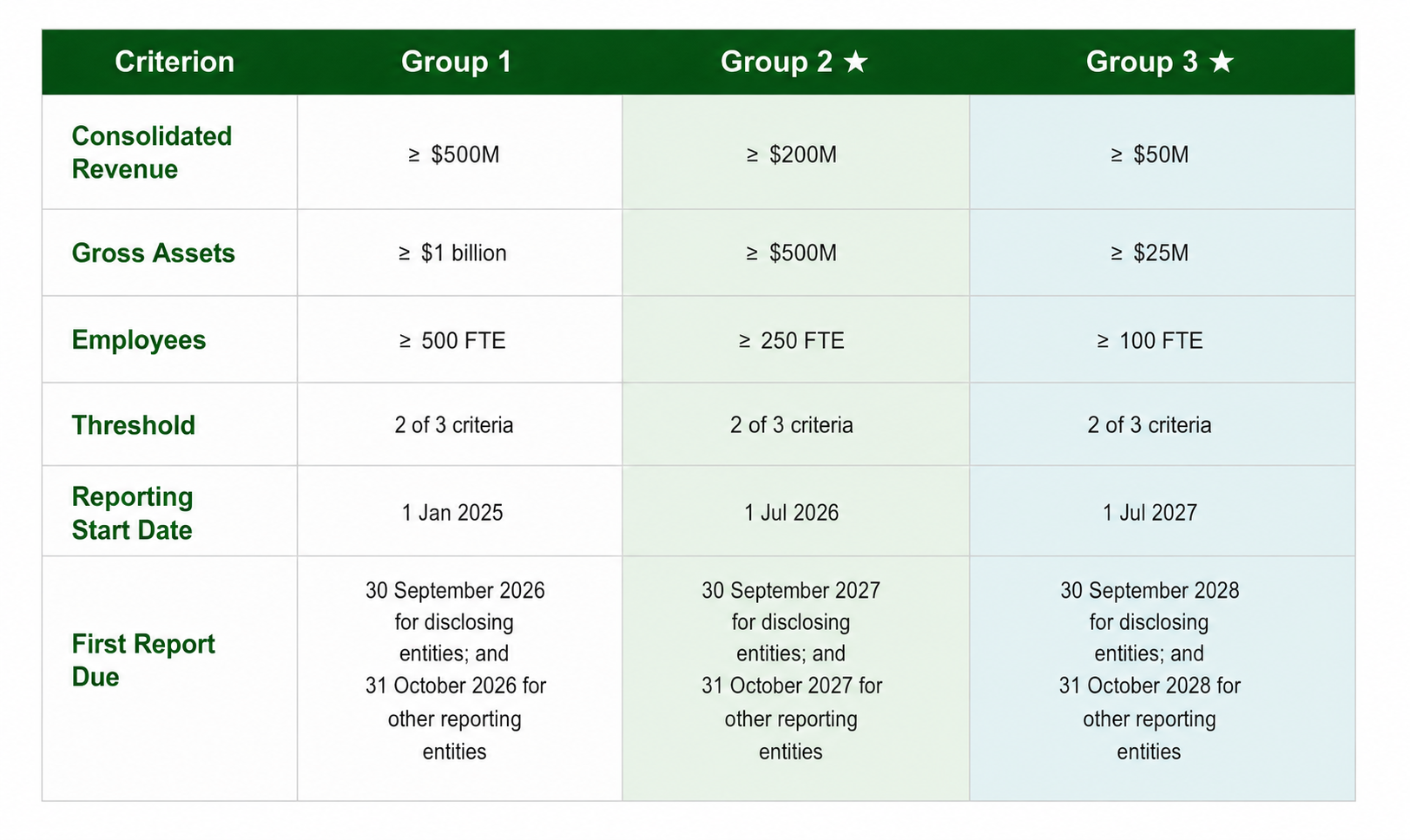
Those deadlines may sound distant, but experience from Group 1 implementation tells a different story. Credible, assurance-ready climate reporting, particularly the quantification of Scope 1, 2, and eventually Scope 3 emissions require substantial lead time to build data systems, train staff, engage suppliers, and establish governance structures.
AASB S2025-1, issued in December 2025, also introduced further amendments to GHG emissions disclosure requirements following lessons from early Group 1 reporters, meaning the standards themselves continue to evolve.[3]
Assurance requirements add another layer of urgency. Under ASSA 5010 (Australian Standard on Sustainability Assurance), entities must have limited assurance over their sustainability report from their first year of reporting. Data that is not traceable, consistently measured, and with a documented methodology will not survive independent assurance review.
There are also significant penalties for non-compliance or misleading disclosures: up to $15 million per contravention, or 10% of annual turnover whichever is greater. Directors who sign sustainability report declarations face equivalent personal liability to financial report sign-offs, making board engagement not merely advisable, but legally necessary.
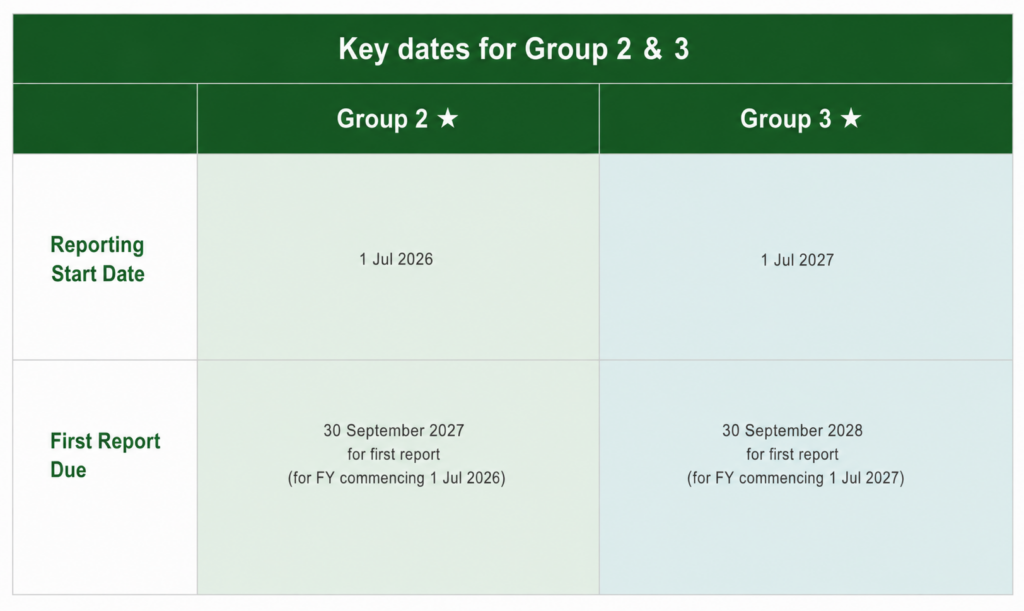
The message from regulators and Group 1 reporters is consistent: START NOW!
Gap analyses, board briefings, GHG data collection programmes, and supplier engagement on Scope 3 emissions all take time that most Group 2 and Group 3 entities have not yet allocated. ASRS is not a future obligation for most mid-market entities, the data collection period for their first mandatory report is already underway.
The experience of Group 1 companies’ mandatory climate-related disclosures is that many were not fully prepared, despite having resources that Groups 2 & 3 may not have.
DataESG assists businesses to develop auditable, climate related financial disclosures, embedded with strong Governance, Strategy, and Risk Management approaches. We help to identify and measure Scope 1, 2 & 3 emissions and report them under Australia’s NGER methodology. We integrate advanced analytics, industry expertise, and personalised guidance to offer a comprehensive, data-driven framework designed to empower companies to navigate the complexities of mandatory climate-related disclosures.
Bibliography
[1] Australian Accounting Standards Board (AASB). AASB S2 Climate-related Disclosures. Issued September 2024. https://aasb.gov.au/admin/file/content105/c9/AASBS2_09-24.pdf
[2] Australian Accounting Standards Board (AASB). Overview of ASRS. April 2025. https://aasb.gov.au/media/xpilzp2e/overviewofasrs_04-25.pdf
[3] Australian Accounting Standards Board (AASB). AASB S2025-1 Amendments to Greenhouse Gas Emissions Disclosures. Issued December 2025. https://aasb.gov.au
[4] Australian Securities and Investments Commission (ASIC). Regulatory Guide 280: Sustainability Reporting. March 2025. https://asic.gov.au/regulatory-resources/find-a-document/regulatory-guides/rg-280-sustainability-reporting/